Childminder accident form: what it must record
In England, a childminder must keep a written record of accidents or injuries and of any first aid given (EYFS 3.77). The framework requires you to tell parents on the same day, or as soon as reasonably practicable. A serious accident, illness or injury must also be notified to Ofsted, or your childminder agency, within 14 days (EYFS 3.78).
Checked 5 October 2026 against the EYFS statutory framework for childminders (in force from 1 September 2026). EYFS statutory framework on GOV.UK.
What the rules say
| What to record | Where it comes from |
|---|---|
| A written record of each accident or injury | EYFS 3.77 |
| Any first aid treatment given | EYFS 3.77 |
| That parents were told the same day, or as soon as reasonably practicable, of the accident or injury and of any first aid given | EYFS 3.77 |
| For a serious accident, illness or injury: that Ofsted (or your childminder agency) was told, and the action taken, as soon as reasonably practicable and within 14 days | EYFS 3.78 |
| For a serious accident or injury: that your local child protection agencies were told, and that you acted on their advice | EYFS 3.78 |
What our form includes
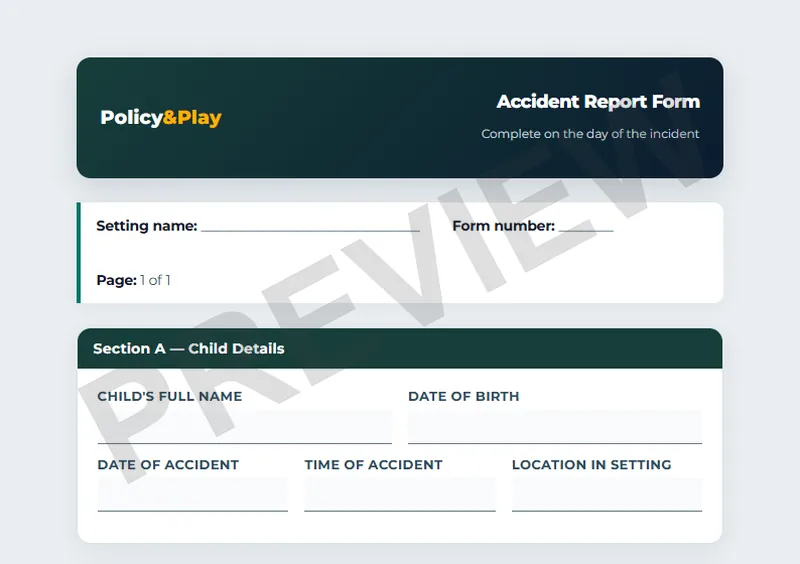
- Child details: name, date of birth, date, time and place of the accident
- A description of exactly what happened, including any witnesses
- Nature and location of the injury, with a body marking and space to note a photograph
- First aid given, who gave it, and whether medical attention was needed
- Parent or carer notification: how, when, and any comments
- Signatures, including a parent or carer signature to confirm they have seen it
- A section for serious accidents: Ofsted or agency notified, and child protection agencies told
- A separate near miss page for incidents that did not cause injury
The full form is part of membership (£14.99 a month or £99 a year).
How to fill it in
- Write the time you noticed it, as close as you can. For example: 10.40am.
- Write what you saw, not what you think caused it. For example: found sitting on the floor crying, red mark on left knee.
- Say which side and which part of the body, so someone who was not there can picture it. For example: left knee, front, 2cm graze.
- Write the date and time you told the parent or carer. The framework requires the same day, or as soon as reasonably practicable.
- Only for a serious accident, illness or injury: write the date and any reference you were given when you told Ofsted.
Common questions
Do parents have to sign a childminder accident form?
No. The EYFS does not require a parent signature on a childminder accident form. The rule (EYFS 3.77) is that you must tell parents about any accident or injury on the same day, or as soon as reasonably practicable. Asking a parent to sign to say they have seen it is good practice and gives you proof.
When must a childminder report an accident to Ofsted?
A childminder in England must notify Ofsted, or their childminder agency, of any serious accident, illness or injury to a child in their care, and of the action taken. Do it as soon as reasonably practicable and always within 14 days (EYFS 3.78). Minor injuries still need a written record under EYFS 3.77.
How long should a childminder keep accident records?
The EYFS says records about individual children must be kept for a reasonable period after the child leaves (EYFS 3.97). It does not set a number of years, so each childminder decides. Your insurer may ask you to keep accident records for longer, so check your policy.
What should a childminder write on an accident form?
A childminder should record the date, time and place, what happened, the injury, the first aid given and by whom, and when and how the parent was told (EYFS 3.77). Write what you saw, not what you think caused it.
Related forms
This is general guidance for childminders in England, not legal advice. Policy & Play is not part of Ofsted or the Department for Education. Always check the official wording.