Childminder medication form: what it must record
In England, a childminder must have a written policy and procedures for giving medicine (EYFS 3.60). Any medicine, prescription or not, must only be given with written permission from the parent or carer for that particular medicine. You must keep a written record each time a dose is given and tell parents the same day, or as soon as reasonably practicable (EYFS 3.61).
Checked 5 October 2026 against the EYFS statutory framework for childminders (in force from 1 September 2026). EYFS statutory framework on GOV.UK.
What the rules say
| What to record | Where it comes from |
|---|---|
| Written permission from the parent or carer for that particular medicine, whether prescription or non-prescription | EYFS 3.61 |
| A written record each time a medicine is given | EYFS 3.61 |
| That parents were told the same day the medicine was given, or as soon as reasonably practicable | EYFS 3.61 |
| For prescription medicine: that it was prescribed for that child by a doctor, dentist, nurse or pharmacist (medicines containing aspirin only if prescribed by a doctor) | EYFS 3.60 |
| A way of getting information about a child's need for medicines and keeping it up to date | EYFS 3.60 |
What our form includes
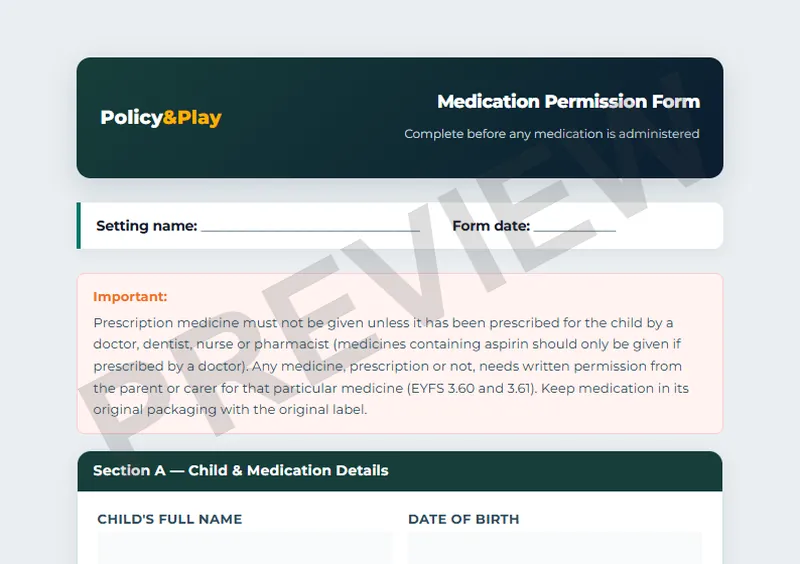
- A permission form to complete before the first dose
- Child and medicine details: name, dose, method, how often, times, expiry date and time of the last dose at home
- Who prescribed it and a check of the pharmacy label
- Possible side effects, storage instructions and any other instructions
- Type of medicine: prescription, non-prescribed or emergency medication
- Period of permission: start date, end date and number of doses
- Parent or carer declaration and signature
- An administration log: date, time, dose, who gave it, signature, any reactions and whether the parent was told
- A parent acknowledgement at the end of the course
The full form is part of membership (£14.99 a month or £99 a year).
How to fill it in
- Copy the dose exactly as it is written on the pharmacy label or packet, for example: 5ml. Do not work it out yourself.
- Ask the parent when the last dose was given before drop-off and write the time. For example: 7.30am.
- Check the label shows the child's name, the medicine and the dose, then note who prescribed it.
- Copy possible side effects from the leaflet in the box or ask the pharmacist, so you know what to watch for.
Common questions
Does a childminder need written permission to give medicine?
Yes. A childminder in England must only give a medicine, prescription or non-prescription, where the parent or carer has given written permission for that particular medicine (EYFS 3.61). The childminder must also keep a written record each time a dose is given.
Can a childminder give an over-the-counter medicine?
Only with written permission from the parent or carer for that particular medicine (EYFS 3.61). The same rule covers prescription and non-prescription medicines. You must record each dose in writing and tell the parent the same day, or as soon as reasonably practicable.
Do parents have to be told when a childminder gives medicine?
Yes. A childminder must inform the child's parents or carers on the same day the medicine has been given, or as soon as reasonably practicable afterwards (EYFS 3.61). A column for this in your administration log makes it easy to show you did.
How long should a childminder keep medication records?
The EYFS says records about individual children must be kept for a reasonable period after the child leaves (EYFS 3.97) and sets no number of years. Your insurer may ask you to keep medication records for longer, so check your policy.
Related forms
This is general guidance for childminders in England, not legal advice. Policy & Play is not part of Ofsted or the Department for Education. Always check the official wording.