Childminder allergy action plan: what it must include
In England, a childminder must have ongoing discussions with parents and, where appropriate, health professionals to develop allergy action plans for any known allergies, and must keep them up to date and share them with all staff (EYFS 3.65). Childminders should refer to the BSACI allergy action plan. A plan from the child's own doctor or allergy clinic comes first.
Checked 5 October 2026 against the EYFS statutory framework for childminders (in force from 1 September 2026). EYFS statutory framework on GOV.UK. BSACI paediatric allergy action plans.
What the rules say
| What to record | Where it comes from |
|---|---|
| Information about any food allergies, intolerances and special health requirements, obtained before the child is admitted | EYFS 3.64 |
| That allergy information is shared with all staff who prepare and handle food, and that it is clear who checks each mealtime and snack | EYFS 3.64 |
| Ongoing discussions with parents and, where appropriate, health professionals to develop an allergy action plan for each known allergy | EYFS 3.65 |
| The plan kept up to date and shared with all staff | EYFS 3.65 |
| A reference to the BSACI allergy action plan (the framework says childminders should refer to it) | EYFS 3.65 |
| All staff aware of the symptoms and treatments for allergies and anaphylaxis, and of the difference between allergies and intolerances | EYFS 3.65 |
What this page does not cover
This page gives no medical advice and no treatment instructions. If a child has a plan from their doctor or allergy clinic, follow that first. The framework points childminders to the BSACI allergy action plan (EYFS 3.65), which you can find on the BSACI website.
What our form includes
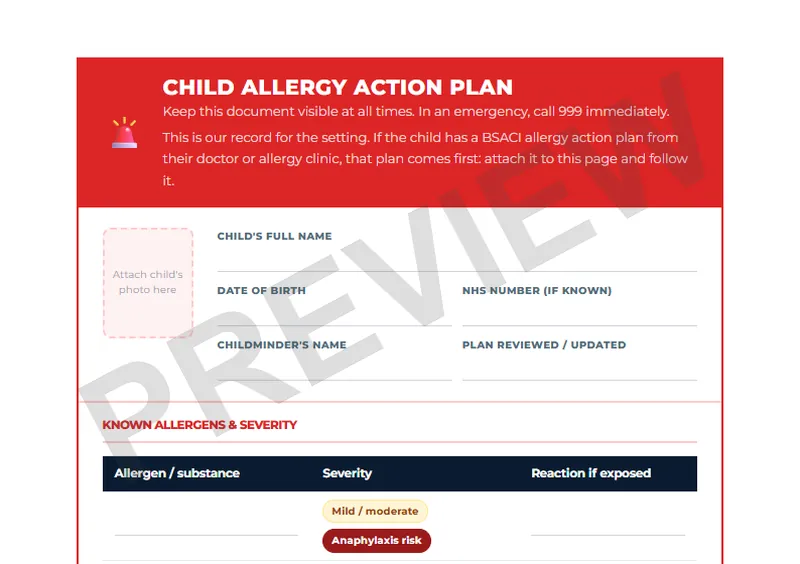
- Child details, photo space, NHS number if known, and when the plan was last reviewed
- Known allergens, how severe each is and the reaction
- Signs to watch for, split into milder reactions and signs of anaphylaxis
- Emergency steps that follow the BSACI paediatric allergy action plan
- Medication details, including whether a BSACI plan is attached, who is trained and where medicines are stored
- Emergency contacts for parents, GP and any allergy clinic
- Parent or carer and childminder signatures
The full form is part of membership (£14.99 a month or £99 a year).
How to fill it in
- Ask the parent for a copy of the plan from their child's doctor or allergy clinic, attach it, and follow it first.
- Complete one form for each child with a known allergy, and write the allergens and reactions in full.
- Make sure everyone who cares for the child can find the plan and knows the symptoms to look for.
- Review the plan when allergens, severity or medicines change. The form suggests a new one at least once a year.
Common questions
Do childminders need an allergy action plan?
Yes, for any known allergy. A childminder in England must have ongoing discussions with parents and, where appropriate, health professionals to develop allergy action plans, keep them up to date and share them with all staff (EYFS 3.65).
What is the BSACI allergy action plan?
It is a paediatric allergy action plan from the British Society for Allergy and Clinical Immunology. The EYFS says childminders in England should refer to it (EYFS 3.65). A plan from the child's own doctor or allergy clinic comes first. The BSACI website hosts the plans.
Who must know about a child's allergy?
A childminder must share a child's allergy plan with all staff (EYFS 3.65), and share information about food allergies and intolerances with everyone who prepares and handles food (EYFS 3.64).
How often should a childminder update an allergy action plan?
EYFS 3.65 says allergy information must be kept up to date and shared with all staff. It does not set a review interval. Our form suggests a new plan at least every year, and whenever the allergens, severity or medicines change.
Related forms
This is general guidance for childminders in England, not legal advice. Policy & Play is not part of Ofsted or the Department for Education. Always check the official wording.