Childminder contract: what to put in it
In England, the EYFS statutory framework does not prescribe a childminder contract, so a written contract is good practice rather than a named requirement. A good one sets out hours, fees, holidays, sickness, notice and consents. If a child takes funded hours, those hours must be free, with no top-up fee. This is general information, not legal advice.
Checked 5 October 2026 against the EYFS statutory framework for childminders (in force from 1 September 2026). EYFS statutory framework on GOV.UK.
What the rules say
| What to record | Where it comes from |
|---|---|
| A written contract with parents at all | Not prescribed by the EYFS: good practice |
| Hours, fees, holidays, sickness and notice period | Good practice: agree these in writing before the child starts |
| Funded hours are free: no top-up fee and no other compulsory charge | DfE statutory guidance, Early education and childcare, paragraphs A1.32 to A1.38 |
| Charges for meals, consumables and optional activities during funded hours are voluntary | DfE statutory guidance, A1.32 and A1.35 |
| No non-refundable registration fee, deposit or retainer as a condition of a funded place | DfE statutory guidance, A1.38 (in force from 1 April 2026) |
| How parents can contact Ofsted (or your childminder agency) if they think you are not meeting the EYFS | EYFS 3.101 |
| Records kept for a reasonable period after the child leaves | EYFS 3.97 |
Funded hours and your contract
If a child takes government-funded hours with you, funded hours must be free. There is no top-up fee and no other compulsory charge for them. Charges for meals, consumables and optional activities during funded hours must be voluntary, and the parent can provide their own instead.
A funded place cannot depend on a non-refundable registration fee, deposit or retainer (statutory guidance from 1 April 2026, paragraph A1.38). Hours outside the funded hours can be charged at your normal rates. Your local authority's provider agreement may add its own rules, so check it before you sign.
What our form includes
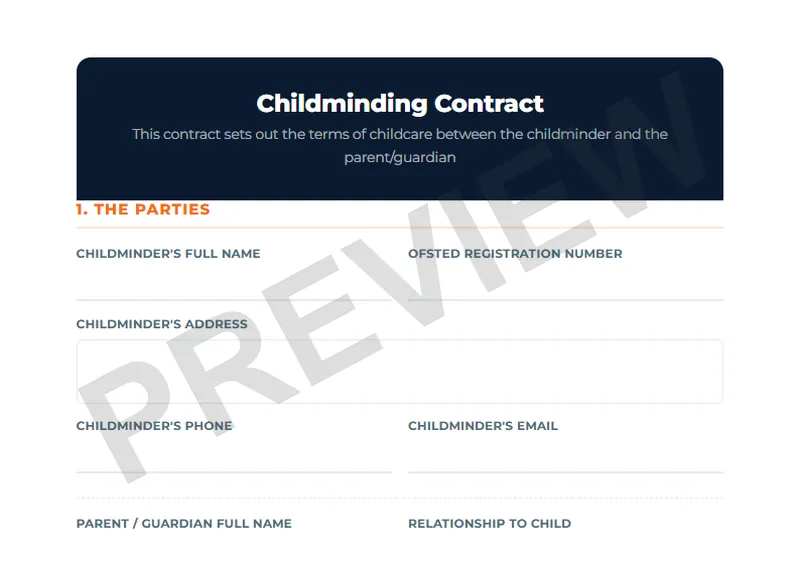
- A panel to enter your details once and fill them through the whole contract
- The parties and the child's details, including allergies and GP
- Hours of care by day, start date and notice for changes
- Fees and payment: hourly, daily and weekly rates, deposit, late collection and late payment
- A funded hours part (4A), with voluntary extras and refundable deposits set out separately
- Holidays, sickness and closures, including settling-in
- Collection arrangements and authorised persons
- Permissions and consents, food and drink, and notice and ending the contract
- Policies, data protection and complaints, then signatures
The full form is part of membership (£14.99 a month or £99 a year).
How to fill it in
- Go through the fee structure, holiday entitlement and notice periods with the parent before anyone signs. Do not rush signatures.
- Print two copies. Both of you sign both copies, and each keeps one.
- Read the reasons for ending the contract straight away and change them if they do not fit how you work.
- If fees or hours change, issue a signed amendment rather than crossing out the original.
- Choose a consistent payment day, for example the 1st of each month, so late payments are easy to spot.
Common questions
Does a childminder have to have a contract with parents?
The EYFS statutory framework for childminders in England does not prescribe a contract, so a written contract is good practice rather than a named requirement. Most childminders use one to agree hours, fees, holidays, notice and consents. This is general information, not legal advice.
Can a childminder charge top-up fees for funded hours?
No. In England, funded childcare hours must be free for parents, with no top-up fee and no other compulsory charge. Charges for meals, consumables and optional activities during funded hours must be voluntary. Hours outside the funded hours can be charged at your normal rates. Check your local authority provider agreement too.
Can a childminder charge a deposit or registration fee for a funded place?
Not a non-refundable one. Statutory guidance in force from 1 April 2026 (A1.38) says a funded place cannot depend on a non-refundable registration fee, deposit or retainer, so any deposit has to be refundable. Your local authority's provider agreement may add its own rules, so check it.
How long should a childminder keep signed contracts?
The EYFS says records about individual children must be kept for a reasonable period after the child has left (EYFS 3.97) and sets no number of years. Your insurer or local authority may ask you to keep some records for longer.
Related forms
This is general guidance for childminders in England, not legal advice. Policy & Play is not part of Ofsted or the Department for Education. Always check the official wording.