Childminder risk assessment: what it must cover
In England, a childminder must take all reasonable steps to make sure children and assistants are not exposed to risks, and must be able to show how they manage them (EYFS 3.92). The framework leaves it to you to decide where a written risk assessment is helpful. For outings you must assess the risks and the steps to manage them (EYFS 3.90).
Checked 5 October 2026 against the EYFS statutory framework for childminders (in force from 1 September 2026). EYFS statutory framework on GOV.UK.
What the rules say
| What to record | Where it comes from |
|---|---|
| All reasonable steps taken so children and assistants are not exposed to risks, and you can demonstrate how you manage them | EYFS 3.92 |
| Written risk assessments where you decide they are helpful, to inform your practice and to show how you manage risks if parents or inspectors ask | EYFS 3.92 |
| What needs checking regularly, when and by whom, and how the risk will be removed or minimised (the framework says assessments should identify these) | EYFS 3.92 |
| For outings: the potential risks or hazards, the steps to remove, minimise and manage them, and staff to child ratios. This need not be in writing | EYFS 3.90 |
| No banned dog breed, including XL Bully type, kept or present on the premises at any time | EYFS 3.81 |
| Safe sleep arrangements for children under 2 | EYFS 3.86 |
What our form includes
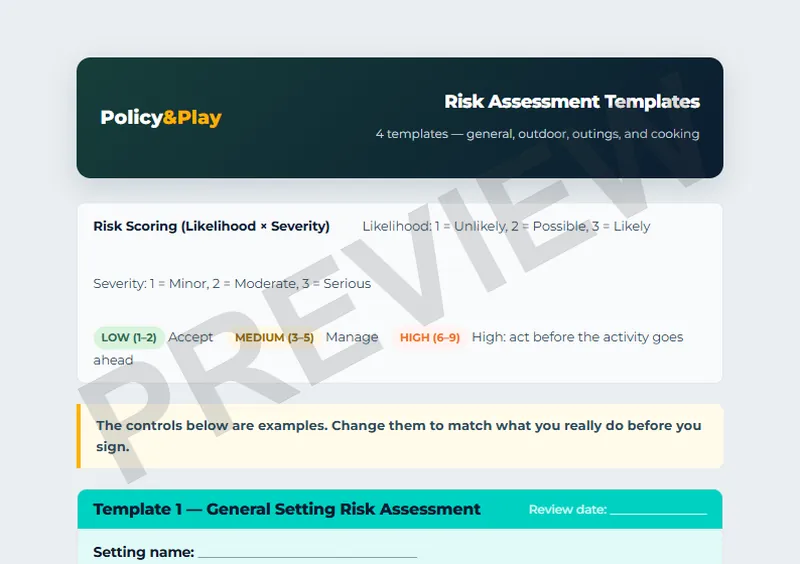
- Four templates: general setting, outdoor play, outings and cooking activities
- A likelihood times severity score: low (1 to 2), medium (3 to 5) and high (6 to 9)
- Columns for the hazard, who is at risk, current controls, likelihood, severity, score and further action
- General setting prompts include dogs and other pets, sleep and rest, fire and evacuation, and security
- An outings template with a before-the-outing checklist
- Example controls to change to match what you really do, plus completed-by and review dates
The full form is part of membership (£14.99 a month or £99 a year).
How to fill it in
- Multiply likelihood by severity to get the score. For example: possible (2) times moderate (2) is 4, which is medium.
- Name the real hazard in your home in a few words. For example: toddler can reach the oven door when it is hot.
- Write what you really do, not what you would like to do. For example: stair gate fitted and closed whenever a child under 3 is here.
- Write one job with a date, or leave it blank if no action is needed.
Common questions
Do childminders need written risk assessments?
Not for everything. A childminder in England must take all reasonable steps to protect children from risks and be able to show how they manage them, and decides where a written risk assessment is helpful (EYFS 3.92). The framework points to HSE guidance on when written ones may be required.
Does a childminder need a risk assessment for outings?
Yes, an assessment is required, though it need not be written. A childminder must assess potential risks or hazards on an outing and identify the steps to remove, minimise and manage them, including staff to child ratios (EYFS 3.90). Whether to write it down is up to you.
What should a childminder risk assessment include?
The EYFS says risk assessments should identify the parts of the environment that need checking regularly, when and by whom they will be checked, and how the risk will be removed or minimised (EYFS 3.92). Your own hazards and controls go in that frame.
How often should a childminder review a risk assessment?
The EYFS does not set how often a childminder must review a risk assessment, but it says assessments should state when and by whom regular checks happen (EYFS 3.92). Our template suggests updating it whenever your activities or environment change.
Related forms
This is general guidance for childminders in England, not legal advice. Policy & Play is not part of Ofsted or the Department for Education. Always check the official wording.