Childminder self-evaluation form: do you need one?
No. In England, Ofsted does not require childminders to complete a self-evaluation form, and leaders are not at a disadvantage if they do not have a written one. The current early years inspection toolkit reports on seven areas: safeguarding, which is met or not met, and six areas graded on a five-point scale. Inspectors may still ask what you do well.
Checked 5 October 2026 against the EYFS statutory framework for childminders (in force from 1 September 2026). EYFS statutory framework on GOV.UK. Ofsted early years inspection toolkit on GOV.UK.
What the rules say
| What to record | Where it comes from |
|---|---|
| A written self-evaluation form | Not required. Ofsted says leaders will not be at a disadvantage if they do not have a written self-evaluation |
| Safeguarding: met or not met | Ofsted early years inspection toolkit, version 2.0 (June 2026) |
| Inclusion, graded on the five-point scale | Ofsted early years inspection toolkit |
| Curriculum and teaching, graded on the five-point scale | Ofsted early years inspection toolkit |
| Achievement, graded on the five-point scale | Ofsted early years inspection toolkit |
| Behaviour, attitudes and establishing routines, graded on the five-point scale | Ofsted early years inspection toolkit |
| Children's welfare and wellbeing, graded on the five-point scale | Ofsted early years inspection toolkit |
| Leadership and governance, graded on the five-point scale | Ofsted early years inspection toolkit |
If you want to write one anyway
A self-evaluation helps you think, and helps you answer when the inspector asks what you do well and what you are working on. Our form follows the seven areas in the order the toolkit uses. Work through one area at a time. Short, honest notes with a real example are worth more than a full page.
What our form includes
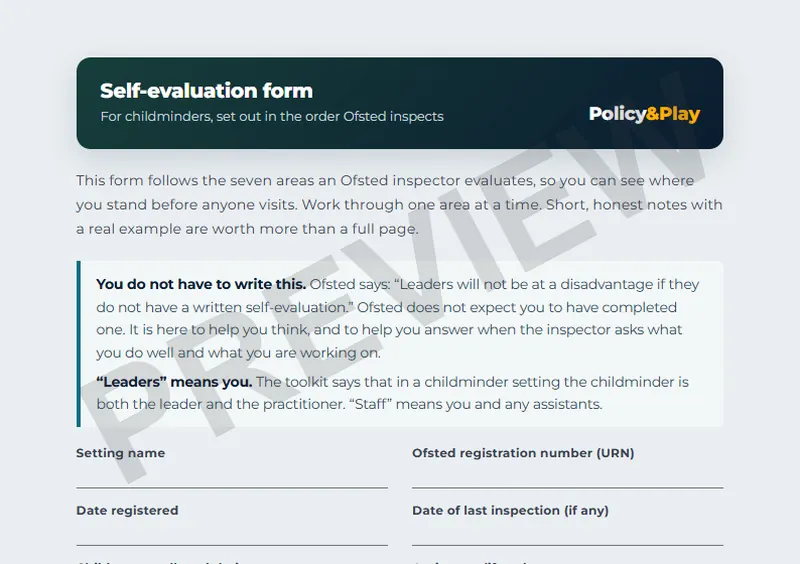
- Setting details, and the date you will look at the form again
- A table of the five grades: exceptional, strong standard, expected standard, needs attention and urgent improvement
- One section for each of the seven areas, with what the inspector looks at, tick boxes and prompts for a real example
- Safeguarding as met or not met, and the other six areas on the five-point scale
- Where an area may not apply, such as care only before and after school for reception-age or older children
- A priorities table with what you will do and by when
- A note on where it comes from: the Ofsted toolkit, version 2.0 (June 2026), from 1 September 2026
The full form is part of membership (£14.99 a month or £99 a year).
How to fill it in
- Describe what really happens, in a sentence or two. For example: I talk to parents at pick-up each day and I write down any worry they raise.
- Pick one real example for each area: what you noticed, who you told and what changed.
- List each no with one job and a date. For example: renew safeguarding training, book it by the end of November.
- Say it in your own words, about the children you have now. Have the toolkit open beside you when you grade yourself.
Common questions
Do childminders have to complete a self-evaluation form for Ofsted?
No. Ofsted does not require childminders in England to complete a self-evaluation form. Ofsted says leaders will not be at a disadvantage if they do not have a written self-evaluation. A written one is a tool to help you think and to answer an inspector's questions.
What does Ofsted inspect childminders on?
The current early years inspection toolkit reports on seven areas: safeguarding, inclusion, curriculum and teaching, achievement, behaviour, attitudes and establishing routines, children's welfare and wellbeing, and leadership and governance. Safeguarding is met or not met. The other six get a grade.
How does Ofsted grade childminders now?
Safeguarding is either met or not met. Each of the other six areas gets one of five grades: exceptional, strong standard, expected standard, needs attention or urgent improvement. There is no overall grade for the setting, because Ofsted reports each area separately, as set out in the early years inspection toolkit.
Why write a self-evaluation if Ofsted does not require one?
It is optional, but it helps you see where you stand before anyone visits, and helps you answer when an inspector asks what you do well and what you are working on. Ofsted does not expect a childminder to have completed one.
Related forms
This is general guidance for childminders in England, not legal advice. Policy & Play is not part of Ofsted or the Department for Education. Always check the official wording.