Two-year progress check: what it must include
In England, when a child is aged between two and three, a childminder must review their progress and give parents or carers a short written summary of their development in the prime areas (EYFS 2.5). The summary must highlight areas where the child is progressing well, and areas where some additional support might be needed (EYFS 2.7).
Checked 5 October 2026 against the EYFS statutory framework for childminders (in force from 1 September 2026). EYFS statutory framework on GOV.UK.
What the rules say
| What to record | Where it comes from |
|---|---|
| A review of the child's progress when they are aged between two and three | EYFS 2.5 |
| A short written summary for parents or carers of the child's development in the prime areas | EYFS 2.5 |
| Areas where the child is progressing well | EYFS 2.7 |
| Areas where some additional support might be needed | EYFS 2.7 |
| A particular focus on any area where there is a concern about a developmental delay that may indicate a special educational need or disability | EYFS 2.7 |
| The activities and strategies you intend to use to address any issues or concerns, involving parents and other professionals as appropriate | EYFS 2.7 |
| A discussion with parents about how the summary can be used to support learning at home | EYFS 2.8 |
| Agreement with parents on when it will be most useful to provide the summary, and encouragement to share it with the health visitor | EYFS 2.9 |
The three prime areas
The EYFS names three prime areas (EYFS 1.4): communication and language, physical development, and personal, social and emotional development. The progress check covers these. Beyond the prime areas, it is for you to decide what the summary includes, reflecting the child's development level and needs (EYFS 2.6).
What our form includes
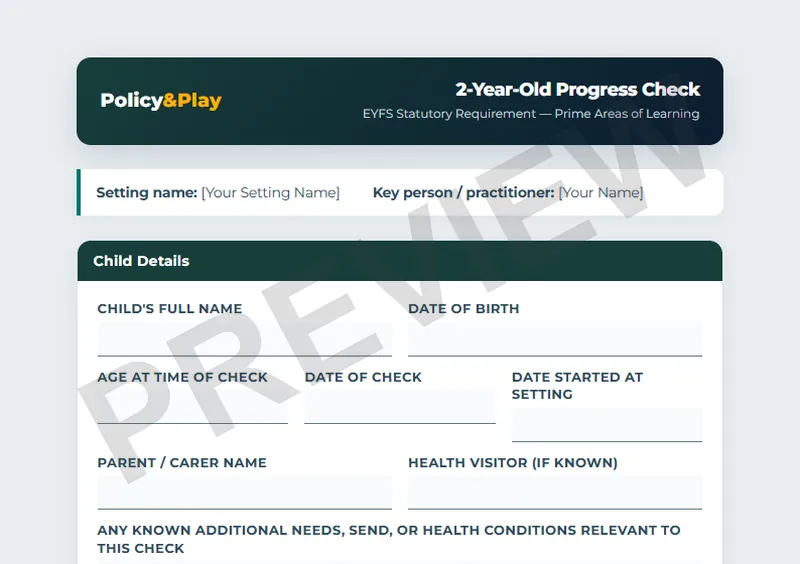
- Child details: name, date of birth, age at the check, date of the check, parent or carer and health visitor
- The three prime areas, split into seven parts such as managing feelings, speaking and gross motor skills
- For each part: a development band (emerging, developing or secure), strengths, areas to develop and next steps. The bands are our own layout, not set by the framework
- Concerns, referrals and additional support
- Parent or carer comments, and whether they agree with the summary
- Whether a copy was shared with the parent and, with their agreement, the health visitor
- Practitioner and parent or carer signatures
The full form is part of membership (£14.99 a month or £99 a year).
How to fill it in
- Pick the band that matches what you see most days, not one good or bad day.
- For a concern, say what you noticed, what you agreed with the parent and who you will contact, with the date.
- Ask the parent what they see at home and write it in their own words.
- Ask the parent whether they are happy for the summary to go to the health visitor, and agree when it will be most useful to send it (EYFS 2.9).
Common questions
When must a childminder do the two-year progress check?
When a child is aged between two and three, a childminder in England must review their progress and give parents or carers a short written summary of their development in the prime areas (EYFS 2.5). If the child moves setting, the check is usually done by the setting where they spent most time (EYFS 2.8).
What must the two-year progress check summary include?
It must highlight areas where the child is progressing well and areas where some additional support might be needed, focus on any concern about developmental delay, and describe the activities and strategies the childminder intends to use to address any issues (EYFS 2.7).
Does a childminder have to share the two-year check with the health visitor?
Not directly. The EYFS says childminders should encourage parents to share the progress check with other professionals, including the health visitor, and must agree with parents when the most useful point to provide the summary will be (EYFS 2.9).
Does the two-year progress check have to be long?
No. The EYFS asks for a short written summary of the child's development in the prime areas (EYFS 2.5), and says assessment should not require excessive paperwork (EYFS 2.2). Beyond the prime areas, it is for the childminder to decide what to include (EYFS 2.6).
Related forms
This is general guidance for childminders in England, not legal advice. Policy & Play is not part of Ofsted or the Department for Education. Always check the official wording.