Childminder existing injury form: what to record
In England, the EYFS does not name an existing injury form, so recording an injury a child arrives with is good practice. Note what you can see, where on the body, and what the parent or carer tells you, in their own words. If you are worried about a child's safety or welfare, you must immediately notify your local authority children's social care team (EYFS 3.10).
Checked 5 October 2026 against the EYFS statutory framework for childminders (in force from 1 September 2026). EYFS statutory framework on GOV.UK.
What the rules say
| What to record | Where it comes from |
|---|---|
| A record of an injury a child arrives with: where on the body, what it looks like, its size and colour | Good practice: no named form in the EYFS |
| What the parent or carer says happened and when, in their words | Good practice |
| Immediate notification of a concern about a child's safety or welfare to your local authority children's social care team (and the police in emergencies) | EYFS 3.10 |
| Records kept securely and available only to people with a right or professional need to see them | EYFS 3.95 |
| Parents given access to records about their child, unless a data protection exemption applies | EYFS 3.96 |
| Records kept for a reasonable period after the child leaves | EYFS 3.97 |
Who to tell about a concern
If you are worried about a child's safety or welfare, the EYFS says childminders must immediately notify their local authority children's social care team in line with local reporting procedures, and the police in emergencies (EYFS 3.10). If a child is in immediate danger, call 999.
The local authority designated officer (LADO) deals with allegations about adults who work with children. A concern about a child's welfare goes to children's social care, not to the LADO.
What our form includes
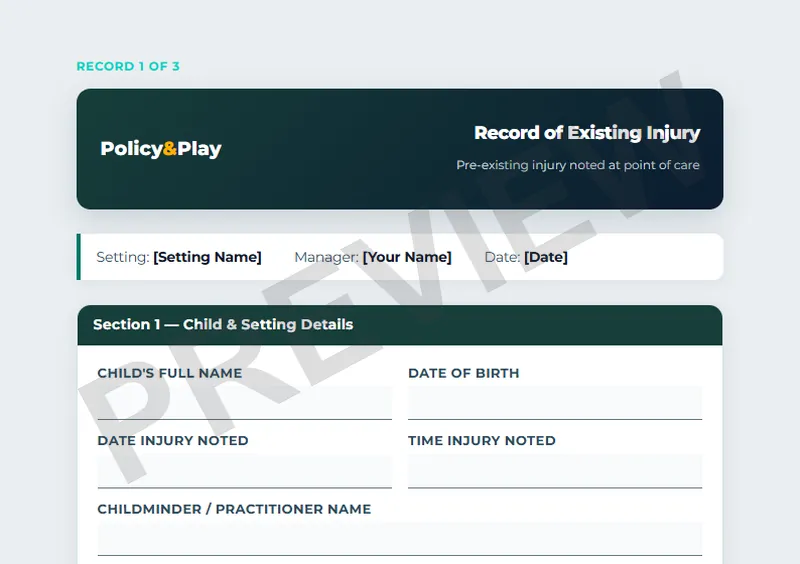
- Three records on each printed sheet, one for each injury noted at drop-off
- Child and setting details, with the date and time the injury was noted
- Description of the injury: location, appearance (bruise, cut or graze, rash, swelling), size and colour
- A front and back body diagram to mark where the injury is
- The parent or carer's account: how and when it happened, and whether medical attention was sought
- Practitioner observations: any concern about the explanation, and any earlier injuries noted
- A safeguarding note on who to contact
- Parent or carer and childminder signatures
The full form is part of membership (£14.99 a month or £99 a year).
How to fill it in
- Say which side and which part of the body. For example: left upper arm, outside, below the shoulder. Write only what you can see, not how you think it happened.
- Compare the size with something everyone knows. For example: about the size of a 10p coin.
- Write what the parent or carer told you, in their words. For example: fell off the sofa on Sunday evening. Keep your own opinion out of that box.
- Tick yes on the concerns box if the explanation does not seem to fit the injury, and write why. A worry about a child goes to children's social care.
Common questions
Is an existing injury form a legal requirement for childminders?
No. The EYFS does not name an existing injury form, so it is good practice rather than a named requirement. If an injury happens while a child is in your care, EYFS 3.77 does require a written record of accidents or injuries and first aid.
What should a childminder do if they are worried about a child's injury?
A childminder in England must immediately notify their local authority children's social care team about any concern for a child's safety or welfare, in line with local procedures, and the police in emergencies (EYFS 3.10). Call 999 if a child is in immediate danger.
Do childminders report safeguarding concerns to the LADO?
Not concerns about a child. A concern about a child's welfare goes to your local authority children's social care team (EYFS 3.10). The LADO, the local authority designated officer, deals with allegations about adults who work with children.
Should a parent sign an existing injury form?
The EYFS does not require it. Our form asks the parent or carer to sign to confirm the account is accurate, which is good practice. Write the account in the parent's own words. A worry about a child's welfare must not wait for a signature (EYFS 3.10).
Related forms
This is general guidance for childminders in England, not legal advice. Policy & Play is not part of Ofsted or the Department for Education. Always check the official wording.